

Educated Immobility
Infrastructure and Its Discontents, Essay No. 3

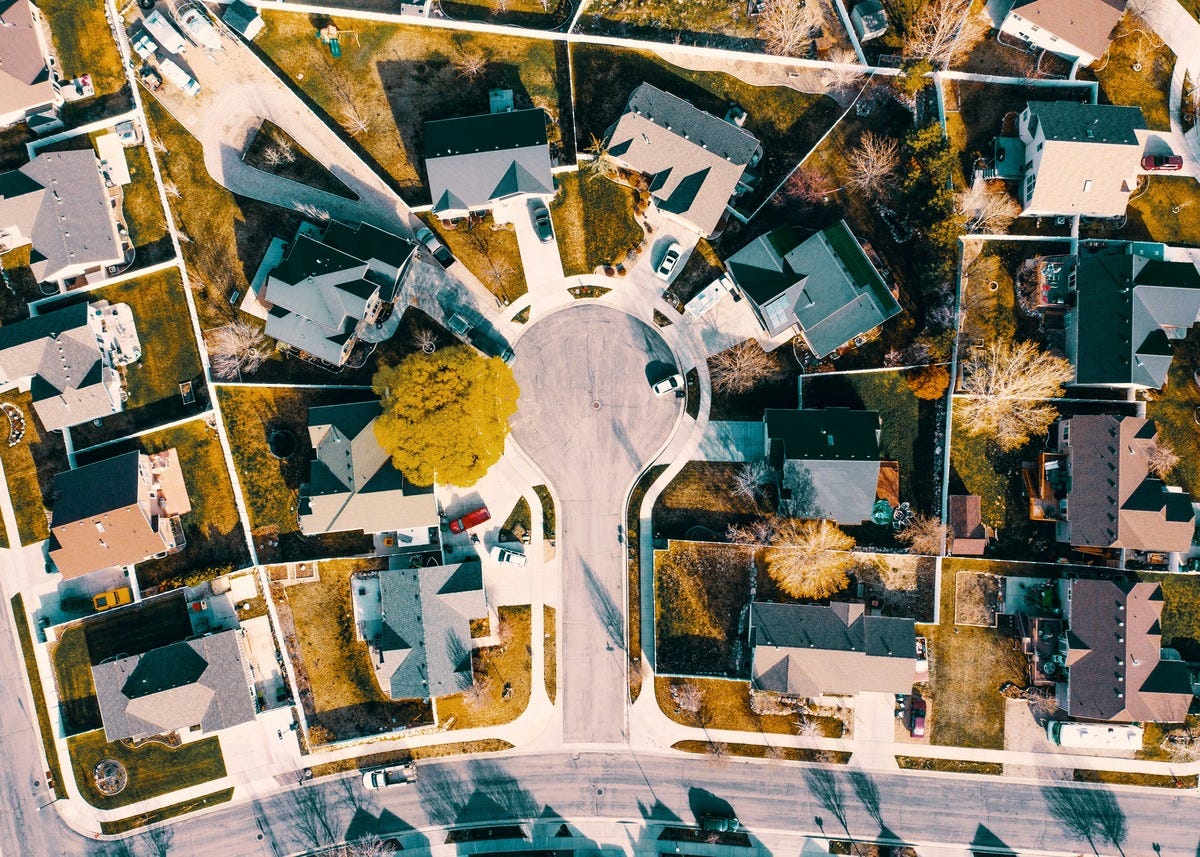
Picture the street. Not a street exactly, a word which implies somewhere to go, but rather a corridor between here and there. What you’re picturing is a loop. It leaves the main road, curves through a cluster of houses set back behind their lawns and driveways, and returns to where it started. A bulb at the end, wide enough to turn a car around. Grass in the center, maybe, or a small concrete island with a sign bearing the street’s name. The houses face each other across a shared space that belongs to no one in particular.
Children play here. This is, in fact, one of the activities the cul-de-sac was designed to enable, a pocket of residential space from which through-traffic has been removed, where the children of these five or six or eight houses can be outside without the street posing a danger to them. It is, in this sense, a form of care expressed in asphalt and geometry.
But notice what the geometry also does. The loop returns to itself. The arterial at its mouth moves car traffic at forty or fifty miles per hour and was built without a sidewalk, because sidewalks were not part of the design program for roads like this one. The local school is two miles away, sited a generation ago at the edge of town where land was cheap. Accessing the nearest store, if there is one, requires crossing that arterial, and then another one, on foot, which is not something a child of eight or nine can do alone and which is not something most adults would ever permit them to try.
The cul-de-sac offers a child a place to be. What it does not offer is a way out.
In the early 1970s, a geographer named Roger Hart spent two years mapping the daily ranges of children in a small Vermont town, where they went, how far they traveled and what territory they moved through without an adult. The ranges were substantial. Children navigated their towns with a freedom that, seen from the present, looks downright romantic. These children roamed across roads, through fields, into neighboring streets, sometimes miles from home. The world, for these children, was something one moved through on one’s own.
Hart returned to the same town decades later. He found the children inside.
Not literally always, but their roaming ranges had contracted dramatically. The independent mobility that had characterized childhood in that place had largely disappeared, replaced by a life of supervised transit: car to school, car to practice, car to a friend’s house, car to get back home. When Hart asked parents why their children’s ranges had shrunk so drastically, they told him what parents have been telling researchers ever since. That is, the roads are too dangerous, the world is too uncertain, you simply can’t let children wander the way we once did.
This explanation is not wrong. However, it is incomplete in a critical way. The roads are more dangerous because they were redesigned, widened, and sped up over the same decades that children’s ranges were shrinking. The world feels more uncertain in part because children no longer move through it independently, and so neither parents nor children accumulate the experience that would make it feel navigable. The cause that parents identify is real. It is also, in significant part, a consequence of decisions made in traffic engineering offices and planning departments and school district administrative meetings, by adults solving problems that had nothing to do with what a nine-year-old needs in order to truly grow up.
The infrastructure changed. The anxiety followed.
Here is what embodied habituation means, and why it matters here.
The body does not move through space as a neutral vehicle. It learns. Through repeated exposure to certain environments, it builds up what the philosopher Maurice Merleau-Ponty called a body-schema, not only a cognitive map or a set of beliefs about the world, but a felt sense of what movement is and what can be reached from here. The body acquires dispositions about where it belongs, what requires caution, where the edge of its own competence lies. These dispositions are not chosen. They form the way posture forms, the way an accent forms, through repetition, through the specific conditions of a particular life, through what the world around us has consistently asked our bodies to do and not do.
The child who moves through a rich independent territory, who crosses streets, reads intersections, gets briefly lost and finds her way back, arrives somewhere alone and feels the place-specific satisfaction of having done so, is building a body-schema in which the world is navigable. In which she is a person who can capably and independently move through it. In which competence is a felt fact about herself and not an abstract aspiration.
The child growing up in the cul-de-sac is building a body-schema too. But a body that is always transported is not the same as a body that has learned to move. The difference is not about distance or exercise. It is about what the body comes to know, whether it carries, accumulated over years of small independent navigations, the felt conviction that the world will receive it. That conviction cannot be taught directly. It forms through experience, or it does not form at all. And the infrastructure, by making independent movement impossible, removes the only conditions under which it could.
This is what I mean by educated immobility. It’s not the absence of education, but a specific curriculum, delivered through the repeated experience of a particular kind of space. The cul-de-sac teaches. So does the arterial without a sidewalk, and the school one can only reach by car, and the neighborhood designed without anywhere to walk to. What they teach, collectively and cumulatively, is a set of bodily dispositions about what movement is and where its limits lie.
Follow that curriculum forward into adolescence, into adulthood, and you begin to see what is at stake.
Psychologists who study identity formation have observed that possible selves, the selves a person can imagine becoming, are not purely cognitive constructions. They are anchored in lived experience. You can imagine becoming what you have some felt evidence you are capable of reaching. The explorer, the wanderer, the person who is comfortable in unfamiliar places and finds her way through them, the person who reads a new city as a navigable space rather than a source of anxiety, these are possible selves that require, as their raw material, a history of having moved through the world and found it manageable.
Competence, in the psychological literature on human development, is not a personality trait or a genetic endowment. It is built from accumulated experiences of having acted effectively in the world. The child who arrives places alone, repeatedly, over years, builds a specific kind of competence that has spatial content: I can navigate. I can figure this out. The world is something I move through, not something that moves me around.
When infrastructure systematically denies children the conditions in which this competence can form, it is not simply depriving them of pleasant outdoor experiences. It is narrowing the range of possible selves available to them. Not dramatically, not in ways that will show up in any single life as an obvious wound. But quietly, structurally, over generations, a contraction in the felt sense of what is reachable, what is navigable, who one is permitted to become.
I want to be careful here about where the blame lands, because the easy target is the wrong one.
The parents driving their children everywhere are not the problem. They are responding, rationally and lovingly, to roads that were redesigned to move cars faster and in greater volume, to schools that were relocated to places unreachable on foot, to a built environment that communicates to anyone paying attention: this is not a place for a child alone.
The cul-de-sac’s designers were likely not trying to produce immobile children. They were trying to remove through-traffic from residential streets, which is a reasonable goal. The traffic engineers who widened the arterials were solving congestion problems, not designing childhood. The school district that consolidated its elementary schools into a single large building at the edge of town was following funding formulas that rewarded efficiency and scale.
Nobody intended the curriculum. But the curriculum ran anyway, because that is what infrastructure does. It shapes the conditions of life, regardless of whether anyone planned for those conditions. It teaches regardless of whether anyone meant to teach. And the lesson, in this case, delivered daily to children across most of the American built environment for the past several decades, is one about limits. About where the edge of your world is. About what requires an adult with a car.
The question is not whether the lesson was intended. The question is whether we are willing to name it for what it is.
What the body does not learn, it cannot easily offer to the self being formed inside it.
The child who has never navigated alone carries that absence forward, not as a wound she can name, nor as a deprivation she can articulate, but as a quiet contraction in the range of what feels possible. She does not know what she is missing, which is part of what makes this a particular kind of loss. The thing that was foreclosed was foreclosed before the person existed who quite likely would have wanted it. She did not choose the cul-de-sac. She did not design the arterial. She was simply placed inside a curriculum and instructed by it, the way children always are, before she was old enough to know she was being taught.
The cul-de-sac returns to itself. It is a very efficient geometric shape. It just doesn’t go anywhere.
Infrastructure and Its Discontents publishes every two weeks. Think back to the farthest you could travel alone at age nine or ten. What was at the edge of that range? What did getting there teach you about yourself? About the world?
Further Reading
Roger Hart, Children’s Experience of Place (1979) and “Containing Children” (2002).
Hart’s original study documented the remarkable geographic freedom of children in a Vermont town in the early 1970s; his return decades later found those ranges had collapsed to a fraction of their former extent. Taken together, the two works constitute one of the most quietly devastating records in the literature on childhood and the built environment.
Maurice Merleau-Ponty, Phenomenology of Perception (1945; English translation 1962).
Merleau-Ponty’s central argument, that the body is not a vehicle for a mind residing somewhere above it but is itself a form of understanding, remains indispensable for anyone trying to think seriously about how space shapes people. The chapters on the body-schema and motor intentionality are the relevant entry points, though they reward slow reading.
Peter Norton, Fighting Traffic: The Dawn of the Motor Age in the American City (2008).
Norton reconstructs the deliberate campaign, waged by automobile interests in the 1920s and 1930s, to redefine the street as a space belonging primarily to cars rather than to the people who had always moved through it. The invention of “jaywalking” as a legal and moral category, specifically targeting children and pedestrians, is one of the book’s most clarifying episodes.
Hazel Markus and Paula Nurius, “Possible Selves” (1986), American Psychologist, 41(9), 954–969.
The paper that introduced the concept of possible selves to psychology: the argument that identity includes not just who one currently is but the range of selves one can imagine becoming, and that this range is shaped by experience. Short, lucid, and remarkably durable for a forty-year-old journal article.
Tim Gill, No Fear: Growing Up in a Risk-Averse Society (2007).
Gill’s book is the most readable overview of how the management of risk in children’s lives, well-intentioned, often reasonable in isolation. Such management has produced, in aggregate, a childhood substantially poorer in the experiences that build competence and confidence. He is clear-eyed about the structural causes without losing sight of the parents navigating them.
I am grateful to see that you are writing about the metaphysics of infrastructure. You are one of those voices in the interwebs that I have come to respect greatly. As for the subject matter of this post, I have serious doubt that concrete alone has the ability to deprive a kid from wondering.
I imagine that you and I would agree that the power which gives the material object, such as concrete, its ability to determine the conditions of user interaction resides in the objects mind than in its mass. Whether the object is a pyramid, an urban square, or an arterial road the power of the material is provided by the purpose or spirit that is given to it by the system's paradigm that shaped it. It is within this deep leverage point of a system where the power to shape minds and concrete truly resides.
I'll end this, the first comment in your new blog, with the following quote:
"Privation is not the act of depriving, but simply and merely a state of want, which is in itself nothing: it is a mere entity of the reason, a mode of thought framed in comparing one thing with another"
~ Spinoza, Letter XXXIV to Blyenbergh.
I look forward to your next post!