
Speed's Promissory Note
Infrastructure and Its Discontents, Essay No. 4

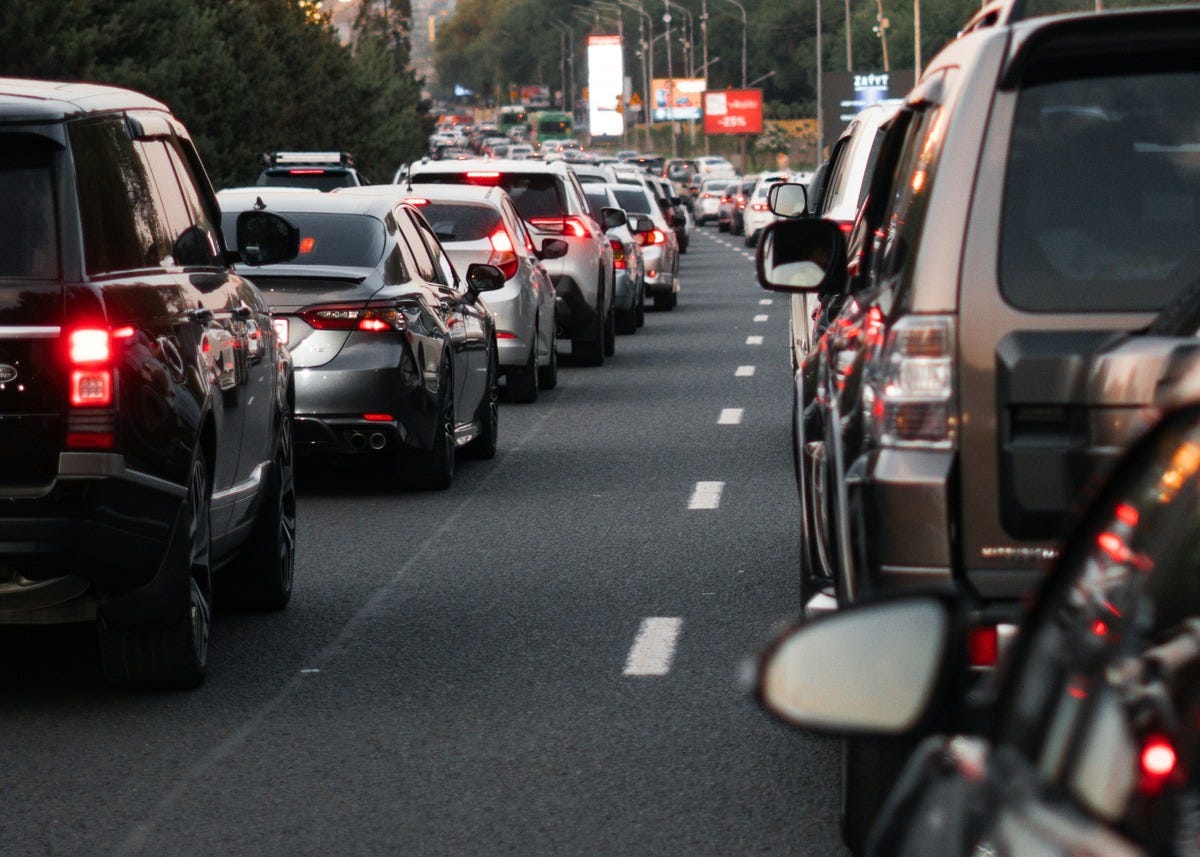
You know this feeling, even if you’ve never named it. You are in a car, on a road built for speed, and the road is not moving. The light ahead has been red long enough that you’ve stopped watching it. The lane to your left is doing the same thing yours is doing: nothing, in increments. The dashboard clock advances by a minute, and then another, and somewhere underneath the simmering irritation is a specific kind of grievance. It’s not that you are late, but that you were promised something which is not being delivered. The road was built for this trip. The road was, in some meaningful sense, built for you. And the road is not working.
That grievance has a name. It is the feeling of a promissory note coming due and not being honored.
The note was written in the language of infrastructure. Wide lanes, grade separations, engineered access points, posted speed limits that describe a different road than the one you are sitting on. It promised time. It promised that the distance between here and there could be managed efficiently, that the friction of getting from one place to another could be reduced to something negligible. The car promised more. It promised freedom, not only from slowness, but from the constraints of schedule and route and dependence that slower, shared, less autonomous forms of movement required. Your car, your road, your timetable. Yours.
The note, as it turns out, was written in disappearing ink.
But the traffic jam is certainly not the deepest problem with the promise. It is the most visible symptom, the one that briefly returns the driver to an awareness the road normally suppresses: that there is a world outside the windshield, that it is passing at a scale the body cannot inhabit, that something was traded away to make this speed possible.
Most of the time, the road successfully suppresses this awareness. This is what speed does to the body before it accomplishes anything else. It doesn’t just move you faster. It recalibrates your sense of what normal feels like, of what counts as an appropriate distance, a reasonable pace, a legible landscape. A body habituated to automotive speed begins to experience walking pace as a kind of deprivation, a failure of the world to meet a need the body has quietly been trained to hold. The slower world doesn’t disappear. It becomes, almost imperceptibly, insufficient.
This recalibration happens without announcement and without consent. It is not a choice the body makes. It is what the built environment induces in the bodies which move through it repeatedly, over years, until the car’s scale is the real scale and everything else is a marginal case. Merleau-Ponty called this motor intentionality, the body’s pre-reflective orientation toward its environment, the way it reaches toward a world it has learned to expect. Speed reshapes this reaching. It narrows what the body anticipates, what it regards as navigable, what it experiences as the right relationship between a person and the ground being traversed.
The texture of the world at walking pace is not simply slower. It is categorically different. You are close enough to smell things, to hear conversations through open windows, to notice the way a particular corner has changed since last week. The body is in continuous negotiation with its surroundings rather than passing through them sealed. The negotiation is not inefficiency. It is a form of being in a place rather than merely transiting it.
Speed ends the negotiation. It abstracts the world into a view from inside glass, legible at a scale of landmarks and exits rather than doorways and faces. And because the road is designed to make this abstraction feel natural, like the default condition of movement, the loss is rarely experienced as loss. It registers instead as the way things are.
Martin Luther King Jr. Boulevard cuts a north-south line through Chapel Hill, North Carolina. It’s northern section sends those using it past apartment complexes and a convenience store and bus stops where people wait in the morning and again in the evening. This northern stretch of the corridor is not a pleasant place to walk. It is wide and loud and moves car traffic at a pace that communicates, in the spatial language infrastructure speaks fluently, that this road was not designed for the person on foot or bike or in wheelchair. There are gaps in the pedestrian infrastructure. There are crossings that require a body to cover significant distance across lanes moving at speed, with signal intervals that do not always accommodate a person who moves slowly, or carefully, or with difficulty.
People walk it anyway, because they live nearby and the convenience store is there and the bus that goes downtown stops on the other side of the road. You walk it because the alternative is not walking it, which is not always an option. The road does not ask whether you have a car. It is simply built assuming you do.
Today, MLK Jr. Boulevard’s northern stretch is a five-lane road. It has been a five-lane road for some time. There are plans to widen it to seven lanes, paired with a significant investment in bus rapid transit along the corridor. The plans follow years of public engagement, genuine commitment to improving transit access, the kind of infrastructure project that arrives wearing the language of equity and mobility. The BRT is real. The intention behind it is real. And the widening will make this road louder, faster, broader, and more hostile to the body crossing it on foot to reach the bus the widening is meant to improve.
This is not a paradox that requires sophisticated analysis to perceive. It is legible to anyone who walks that road now and can imagine walking it after. The bodies that currently navigate that corridor on foot to the convenience store, to the bus stop, across to the other side were not the subjects of the public engagement process that shaped the widening. The BRT had years of community conversation. The additional lanes arrived as engineering consequence, technical necessity, the part of the project that doesn’t require a meeting because it isn’t understood as a choice.
Langdon Winner observed that artifacts have politics, that the decisions encoded in built form are value-laden even when they are presented as neutral. The widening of MLK Jr. Boulevard is a political decision rendered as infrastructure logic, and the people most affected by it as a daily somatic experience were not present when it was made.
On a Thursday evening, at 7:40 p.m., a man named Christian Albert Ball was crossing Martin Luther King Jr. Boulevard near Taylor Street, between Estes Drive and Homestead Road. He was 63 years old. He had been to the convenience store. He was struck by a vehicle and taken to UNC Hospitals, where he died of his injuries.
This and several similar system failings happened on the five-lane road. The road as it exists today. The road that was already there.
The public record gives him a name, an age, a road, and a time of death. It gives the road a brief lane closure and an investigation. Chapel Hill police noted that inebriation on the part of the pedestrian was suspected, though no evidence was offered. The driver remained on scene.
The suspected inebriation is worth pausing on because of the work it does regardless of its truth. It moves the cause of the death from the road to the man crossing it. It locates the failure in his body rather than in the design of a corridor that required a 63-year-old man to cross multiple lanes of moving traffic in low light to get home from the store. The road, which had already rendered its verdict on who belonged there and at what speed, is absolved a second time. Christian Albert Ball, who cannot speak, is made to explain himself.
This is how infrastructure escapes accountability. Not through conspiracy but through the ordinary operation of an interpretive apparatus that was never designed to ask what the road owed the person on foot. The question the apparatus knows how to ask is whether the pedestrian made a bad decision. The question it does not know how to ask is whether the road did.
The plans to widen that road to seven lanes were not developed in response to his death. They were not developed with his death in view. They were developed to improve automotive flow, which is important to some and pursued by people acting in good faith. The road that failed Christian Albert Ball is the road we are planning to make larger.
Iván Illich, writing in the early 1970s, made a calculation that has aged surprisingly well. He estimated that the typical American, when all the hours spent earning the car, maintaining it, insuring it, parking it, and sitting in it were factored against the miles it produced, was traveling at an effective speed of roughly five miles per hour. The cyclist, by comparison, was faster. Not in operating speed, but in what Illich called social speed, the actual rate at which a person moved through the world when the full cost of their movement has been honestly counted.
The calculation is fifty years old and the specific numbers have shifted, but the structure of the argument has not. The car’s promise was time, more of it, freed from the friction of slower movement. What the car really produced, at the scale of a life, was the colonization of time by the needs of the car itself, i.e., the commute added when roads induced sprawl, the hours at the pump and the mechanic, the income devoted to auto insurance and payments, the years of a working life spent funding the machine that was supposed to liberate the working life. The note promised time and extracted it.
Illich called this counterproductivity: the tendency of systems, past a certain threshold of intensity, to produce the conditions they were originally designed to address. The road built to solve congestion generates the traffic that produces congestion. The speed that promises to save time consumes it. The infrastructure of freedom produces dependence, on the car, on the road, on the income required to sustain both, on the land use patterns that make all of it inescapable.
The body knew this before Illich named it. The body crossing MLK Jr. Boulevard to catch a bus it can barely reach knows something about the counterproductivity of a road designed for speed. The body that has slowly stopped walking a route it walked for years, not because the route became dangerous overnight but because it became loud and hostile and scaled to something other than a person, knows something about what speed costs that no benefit-cost analysis will ever capture.
The arithmetic comes as confirmation. The somatic knowledge came first.
The promise was freedom. That is what makes the inversion worth naming.
Not freedom in the thin sense, such as the ability to go somewhere quickly. The deeper promise was autonomy: release from the dependencies and schedules and constraints of a life organized around shared, slower, less individuated movement. The car would make you sovereign over your own transit. The road would make that sovereignty possible at scale. You would not need to wait for the bus or coordinate with neighbors or organize your life around the logic of a network built for others. You would have your own network, personally scaled, available on demand.
What the road produced instead was a different set of dependencies, less visible because they were built into the landscape rather than printed on a schedule. Dependence on the car that required income that required a job that required a commute that required a car. Dependence on land use patterns designed for automotive access that made walking not just inconvenient but, in many places, physically dangerous. Dependence on a system of speed that recalibrated the body’s sense of normal so thoroughly that the slower world, the one that preceded the promise, no longer felt like freedom but like its absence.
Christian Albert Ball walked to the convenience store on a five-lane road and did not make it home. The road had no adequate provision for the crossing he needed to make, no framework that asked what the corridor owed the person on foot in low light conditions. He was, in the spatial language the road speaks, a marginal case.
The promissory note was never written for him. That is the argument in the asphalt.
Further Reading
Iván Illich, Energy and Equity (1974) The source of the social speed argument at the heart of this essay. Illich’s central claim, that beyond a certain threshold, motorized speed produces the time poverty it was meant to solve, remains one of the most clarifying ideas in the literature on infrastructure and modern life. Short, polemical, and still surprising.
Iván Illich, Tools for Conviviality (1973) The broader framework from which Energy and Equity emerges. Illich develops the counterproductivity argument across the institutions of medicine, education, transportation, and articulates what he means by convivial tools, i.e., those that enhance rather than diminish the agency of the person using them. Essential background for where this newsletter is heading.
John Urry, Mobilities (2007) A sociological account of how automobility reorganizes not only movement but social life, identity, and the body’s relationship to place. Urry’s concept of the car as an iron cage of modernity extends Weber in ways directly relevant to the freedom inversion this essay names at its close.
Wow - such an elegant essay. Thank you.
"Speed ends the negotiation."
Excellent post, Seth!
Hard to go wrong with Iván's insight, right?